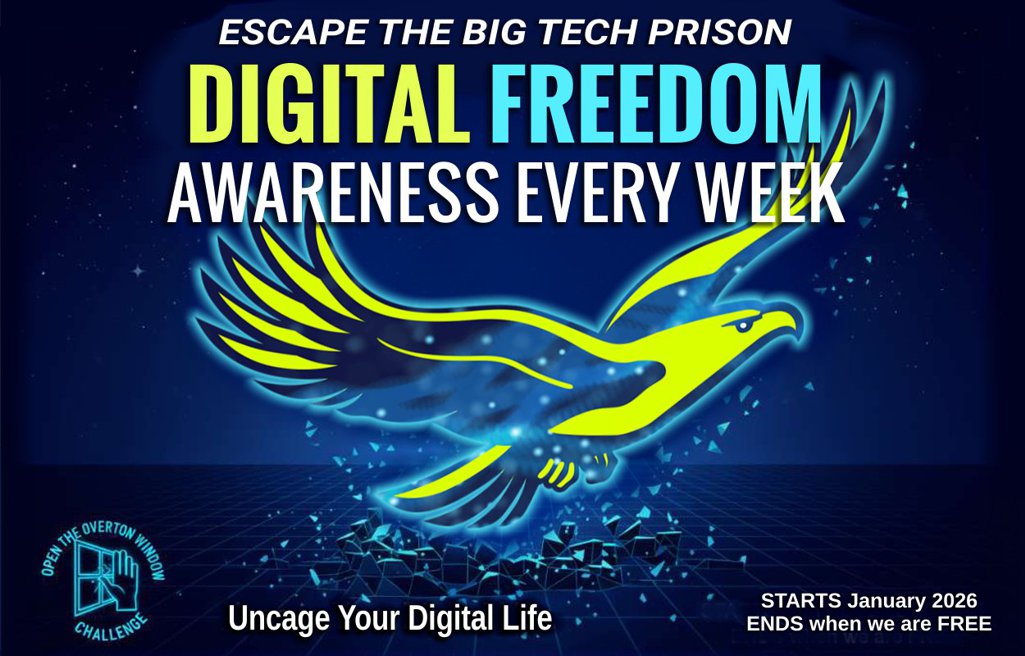
Digital Freedom Awareness Every Week
is a global, ongoing initiative to help people take back control of their digital lives, one week at a time.
Every week is built around seven themed days, each one focused on a core area of Digital Freedom:
This is not about politics. It’s about something far deeper:
the foundation of human liberty in the digital age.
Digital Freedom Awareness Week and the Open the Overton Window Challenge are not just events, hashtags, or another “online campaign.” They are part of a broader effort to wake people up to the reality of the digital prison being quietly built around us – and to give them practical ways to push back.
Privacy, free speech, and the right to connect without surveillance or censorship are not left or right, not national or tribal—they are universal human rights that every person deserves. You don’t need to belong to any party, ideology, or nation to see what’s at stake.
This initiative is about building Digital Freedom Awareness and equipping you with:
Digital Freedom Awareness Week is about choosing freedom and showing, in numbers that cannot be ignored, that we will not consent to digital slavery.
It’s an invitation to:
- Open the Overton Window around digital freedom—safely, creatively, and effectively.
- Stand together against the emerging digital prison.
- Help build a better digital world for the next generation, where autonomy, privacy, and human dignity are the default, not the exception.
Cybersecurity and Your Privacy are not the same
The inspiration for Digital Freedom Awareness Week came from becoming aware that very October, governments, corporations, and educational institutions worldwide united for Cybersecurity Awareness Month, a global initiative that claims to promote online safety and digital protection.
This is about protecting their systems – not protecting you.
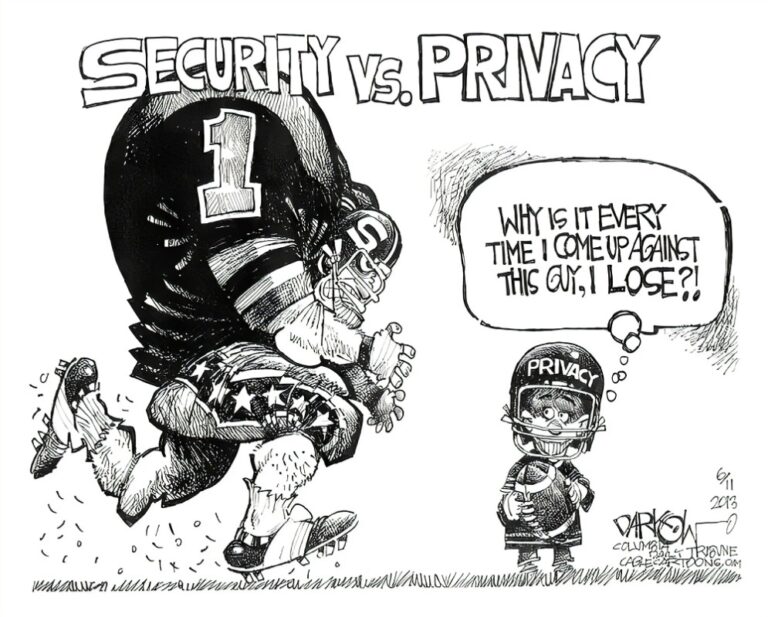
Cybersecurity and Privacy are not the same thing.
Cybersecurity is about protecting networks, devices, and data. Digital Freedom is about protecting rights to privacy, freedom of expression, and uncensored access to information. The distinction matters. They present their “cybersecurity” as if they automatically include your privacy and protection – they don’t.
While some participants are no doubt sincere, the reality is that most of the forces behind national cyber-awareness drives have little to do with protecting your privacy or your Digital Freedom. Governments want more control, Big Tech wants more data and market dominance, and banks and telcos want cheaper fraud bills. They are building the digital prison but it’s nice of them to care about keeping us “safe” inside.
Big Tech tells you to learn cybersecurity to “protect yourself,” but what they really mean is protecting their data – your personal information. To them, you’re the commodity, and they gather far more about you than you realise.
The Big Tech / Big Brother sponsored Cybersecurity Month works from a threat model that focuses on protecting you from these guys:
Cybercrime – Hacking – Malware – Phishing – Social engineering

…while assuming these guys are your trusted friends:
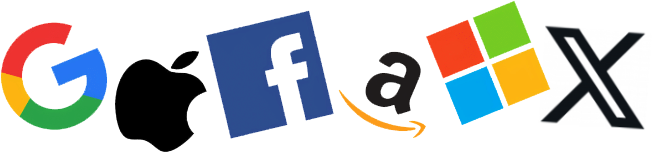
Big Tech is treated as if their surveillance and data harvesting practices don’t pose any threat to your privacy when in reality, they are the primary architects of the Digital Prison
Much of the advice you’ve been given is based on the wrong threat model
The Threat Model promoted by Digital Freedom has all the same external threats (cybercrime), but also includes the system that wants to monitor, filter, and monetise every aspect of your digital life.
Digital Freedom Awareness Every Week
Digital Freedom Awareness Week Offers An Alternative
Digital Freedom Awareness Week is launching as a weekly initiative to stand as an alternative program to Big Tech and Big Brother‑sponsored Cybersecurity Awareness Month. The aim is to highlight what’s missing from the official conversation.
We’ve realised that a single week or even a month of “awareness” is not enough. Digital Freedom isn’t a once‑a‑year theme – it’s a practice you need to work on every day. That’s why each week in this ongoing initiative features seven themed days, each dedicated to a core aspect of Digital Freedom.
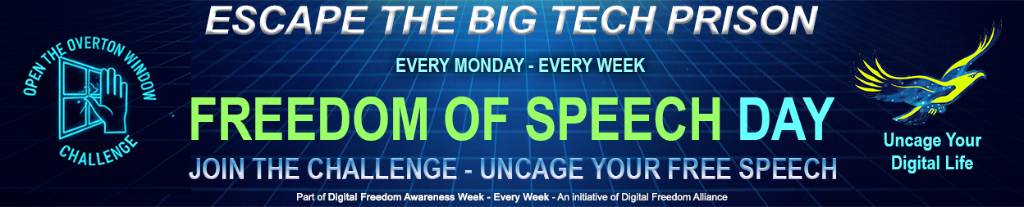
FREEDOM OF SPEECH DAY
Around the world, people are being silenced, censored, fined, and even arrested for so-called “wrong think.” Too often, this is disguised under terms like hate speech, misinformation, or harmful content. The result is the slow suffocation of public discourse and the erosion of truth itself.
The focus of Freedom of Speech Day – 26 January 2026 is the launch of the challenge called: Open the Overton Window Challenge which ends when we open the Window. This is about asserting our right to speak. The Overton Window is what is considered acceptable to say and Big Tech and Big Brother have jammed the window closed on certain topics and opinions. The Push the Overton Window Open Challenge is about tapping or pushing on that Window for the week in numbers that can’t be ignored. While we do not condone breaking any laws, it is ultimately each persons decision where you push and how hard you push as long as they are fully informed and accept any consequences.
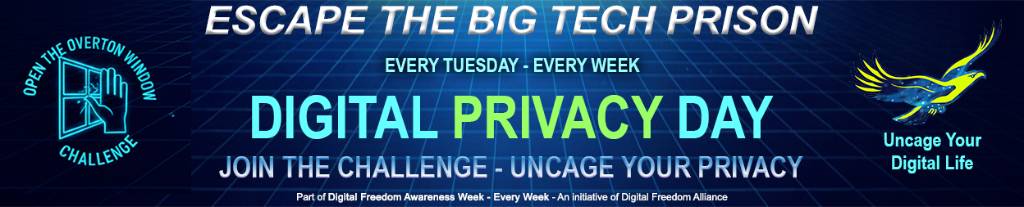
DIGITAL PRIVACY DAY
Today’s battleground is not freedom of speech alone; it is who controls the internet itself. Under the guise of protecting children from harm, governments and corporations are rolling out measures like the Zero Trust Internet 2027 plan (originating in the U.S. Department of Defence). In reality, this is the framework for a global Digital Prison: a mandatory Digital ID, surveillance baked into the core of the web, to track and control every aspect of your Digital Life..
The focus Digital Privacy Day this week is on exposing this creeping takeover. We highlight the dangers of Big Tech’s “Big Brother” systems, how they erode personal privacy, and how digital IDs will be weaponised to enforce control. Participants will share content, articles, and resources that make it clear: privacy is not paranoia — it is power.
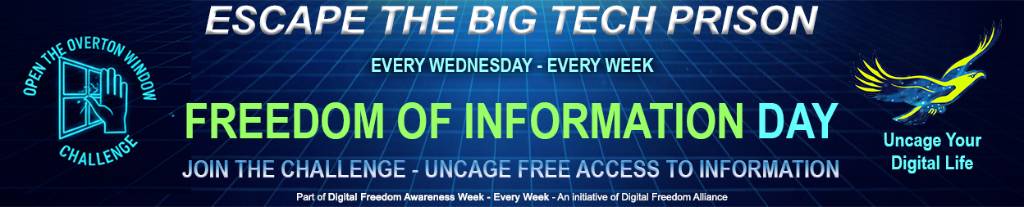
FREEDOM OF INFORMATION DAY
The most effective form of control is not a prison we can see but from a prison that hides information limiting our choices and without full access to competing ideas and information your ability to make informed decision. The Digital Prison removes or restricts access to ideas and opinions that not part of the “approved” narratives. This is the Digital Prison.
The focus of Freedom of Information Day this week is on exposing how censorship, both government-enforced and algorithmic, narrows the field of available choices. Whether misinformation labels, shadow banning, or flat-out removal, the end result is the same: a world where people live inside a curated bubble of control. There are better alternatives and that is the focus of Thursday.
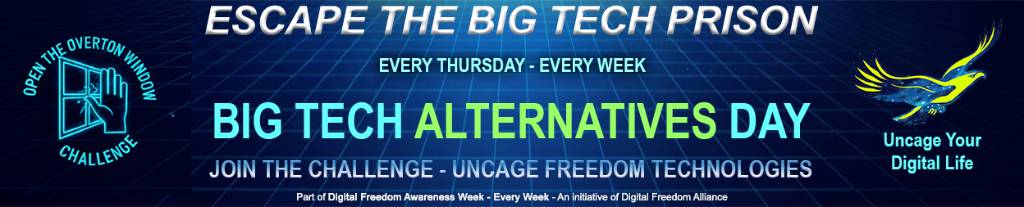
BIG TECH ALTERNATIVES DAY
Big Tech lures people in with “free” services while surveilling every click. Even so-called “private” platforms like WhatsApp are tied into corporate ecosystems with backdoors and data collection agreements. We cannot resist tyranny while giving tyranny full access to all your private communications
The focus for Big Tech Alternatives Day this week is the basic right to have a private conversation, showcasing privacy-focused FOSS-based communication alternatives offering encrypted email and messaging services.
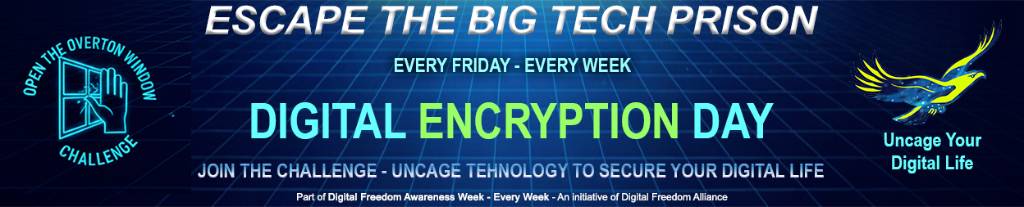
DIGITAL ENCRYPTION DAY
Encryption is a critical part at the very heart of digital freedom systems providing protection to your data, but most people don’t understand it.
The focus for Digital Encryption Day this week will be on the difference between CBDCs and Cryptocurrencies and understanding encryption keys and ownership.
DECENTRALISED TECHNOLOGY DAY
Decentralisation is the antidote to centralised systems of control, shifting power and decision‑making back into the hands of people. By promoting decentralised technology, tools like open networks, peer‑to‑peer systems, and distributed governance act as a barrier against surveillance and centralised dominance
The focus of Decentralised Technology Day this week is how Centralised AI is being used to construct the digital prison, while decentralised AI can help us escape to digital freedom and if we don’t harness the power of AI for freedom, it will be used for our enslavement.
DIGITAL FREEDOM FOR THE NEXT GENERATION DAY
Big Tech and Big Brother have dismally failed to protect children online. Instead, governments now exploit the issue to propose mandatory IDs for children accessing the internet, claiming it is for their safety. In reality, this is part of the Zero Trust Internet 2027 plan: another brick in the Digital Prison. The truth is that children do not need IDs or surveillance – they need families and communities committed to protecting them and building healthy alternatives.
The Focus of Digital Freedom for the Next Generation Day this week is Protecting Children in a Toxic Digital World and calls for parents and communities to take direct ownership of protecting their children’s digital lives. This means building alternative digital spaces aligned with cultural, ethical, or religious values building their own networks or communities and sharing resources.
This is your invitation to reclaim what’s rightfully yours. Whether you share a post, join a discussion, or simply spread the word, every action you take towards Digital Freedom Awareness is a brick removed from the digital prison. Your voice is your power, and together, we can ensure that the future of the internet is built on freedom, not control.
Digital Freedom Awareness Week
Reclaim Your Rights. Resist the Control. Build Digital Freedom.